Free AI readiness consultation: The Recce
One focused hour to understand how AI is already being used, test one or two candidate processes and check the hazards before you commit further time, budget or attention. No technical brief required.
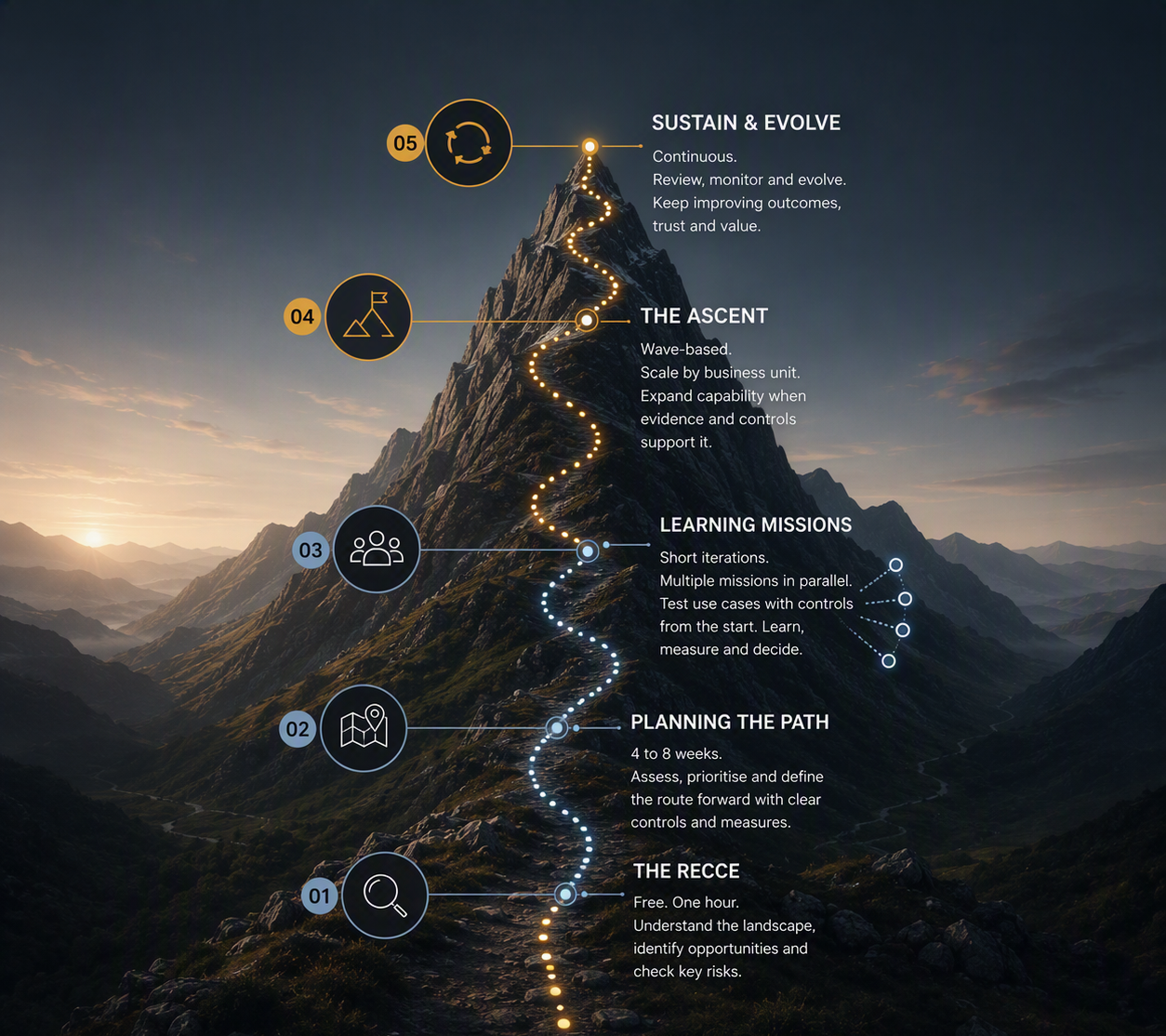
Where should your organisation start with AI?
Most organisations do not have a shortage of AI ideas. The difficulty is working out which ideas are useful, which are already happening without clear oversight and which could create more risk than value.
People may already be using public AI tools to draft documents, analyse information or support customer work. A leadership team may have several possible use cases but no agreed priority. A process may look suitable for AI, yet depend on sensitive data, professional judgement or systems that are not ready.
The Recce creates enough clarity to decide what deserves a closer look.
It is not a sales presentation and it is not a full AI assessment. It is a focused AI readiness consultation that surfaces the current position, examines one or two practical processes and checks for the hazards most likely to affect value, trust or delivery.

Why organisations book The Recce
The Recce is useful when:
- AI is already being used by employees, with or without formal approval
- leaders know AI matters but do not know where to begin
- several teams are testing different tools without a shared view
- there are too many possible use cases and no clear priority
- a manual process looks suitable for AI but has not been properly examined
- privacy, security or accuracy concerns are stopping progress
- there is pressure to invest before the value or risk is understood
- employees are concerned about jobs, skills or accountability
- an existing AI tool is creating activity but not improving the process
- the organisation needs an independent view before planning further work
The aim is not to solve the whole problem in an hour. It is to establish whether there is enough signal to plan a sensible next step.
What is The Recce?
The Recce is a free AI readiness consultation for SMEs, mid-market organisations and third-sector teams that need a clearer view of where AI may add practical value.
During the conversation, AI Terrain reviews current AI use, including activity that may not yet be formally sanctioned. We then examine one or two candidate business or service processes and run a standard AI hazard check.
By the end, there should be enough signal to decide whether to stop, gather more evidence or plan the path towards a fuller AI feasibility assessment.
The Recce is normally one hour. A 15 to 20-minute fast-track version is available when the contact already understands the problem, process and AI context. The hazard check is never skipped.
What we cover in one focused hour
01. Current AI use, sanctioned or not
We establish where AI is already appearing in the organisation. This may include approved tools, individual experimentation, supplier features or shadow AI use that has developed without formal ownership.
The purpose is not to catch people out. It is to understand the real starting point and identify where useful activity, duplication or unmanaged risk may already exist.
02. One or two candidate processes
We focus the conversation on one or two recognisable processes rather than discussing AI in the abstract.
We look at the outcome, the people involved, where time or quality is being lost and where judgement, expertise or relationships create value. This helps test whether AI is relevant to the problem rather than simply available.
03. The standard AI hazard check
We check the areas most likely to affect whether an opportunity is safe, useful and deliverable.
The depth depends on the conversation, but the check considers value, data, privacy, security, accuracy, people, accountability, legal or ethical concerns, systems and practical ownership.
04. Enough signal to plan the path
The Recce ends with a direct view of what the evidence supports.
There may be a candidate process worth assessing in more detail. The organisation may need to address a data, policy or ownership issue first. The best decision may also be to pause because AI is not currently the right answer.
[CTA HERE: TEST YOUR AI OPPORTUNITY]
What does the AI hazard check look for?
The hazard check is a proportionate first review, not a full technical, legal or security assessment.
It looks for early warning signs and important unknowns across areas such as:
Business value
Is there a clear problem and useful outcome, or is the idea being driven by pressure to use AI?
Process and human value
Which parts of the work could be supported, and where must people retain judgement, creativity, relationships or accountable decision-making?
Data and privacy
What information might be required? Is it sensitive, poorly controlled or unsuitable for the proposed use?
Security and supplier risk
Which tools or providers are involved, and are there unanswered questions about access, retention, processing or model training?
Accuracy and reliability
What happens when the output is wrong, incomplete or uncertain? Who reviews it before it affects an important action or decision?
Ownership and governance
Who owns the process, the data, the decision and the ongoing use of the tool?
Systems and delivery
Can the opportunity work with existing systems and teams, or are there dependencies that need deeper investigation?
A hazard does not automatically rule out an opportunity. It shows what must be understood or controlled before the organisation moves further.
What happens during The Recce?
The conversation is structured but not scripted around a generic questionnaire.
Together, we will:
- Clarify why the conversation is happening now
- Review how AI is already being used across the organisation
- Select one or two candidate processes to examine
- Understand the desired outcome and the current way of working
- Identify where people create value and retain accountability
- Run the standard AI hazard check
- Decide whether there is enough signal to plan the next stage
The discussion is designed for business leaders. You do not need specialist AI knowledge, a technical specification or a preferred platform.
What will you leave with?
The Recce is intended to give you a clearer decision, not a large report or an automatic route into a paid engagement.
You should leave with:
- a clearer view of current AI use, including activity that may lack formal ownership
- one or two candidate processes that have been discussed in practical terms
- visibility of the main hazards, assumptions and unanswered questions
- a view on whether further assessment is justified
- a clearer next step, which may be to proceed, prepare, pause or stop
The Recce does not produce a detailed roadmap, business case, security design or implementation plan. Those require deeper evidence and a properly scoped AI feasibility assessment.
Already clear on the problem? Use the fast track.
A 20 – 30-minute fast-track Recce is available when the contact can clearly explain:
- the process being considered
- the current problem or pressure
- how AI is already being used
- the outcome the organisation wants
- the people, data and systems involved
The shorter format removes unnecessary background discussion. It does not remove the AI hazard check.
If the conversation shows that important information is missing, AI Terrain will say so rather than force a conclusion into the shorter time available.
[CTA HERE: BOOK A FAST-TRACK RECCE]
Who is The Recce for?
Recce is designed for people who understand the organisation and its problems but may not have specialist AI capability in-house.
This commonly includes:
- founders and managing directors
- finance and commercial leaders
- operations and service leaders
- people and HR leaders
- risk, compliance, security and data leaders
- programme and transformation leads
- third-sector chief executives and service leaders
- technology leaders who need business alignment before deeper technical work
It is particularly useful when the organisation needs a candid external view before it commits to tools, consultancy, development or a formal AI programme.